Chelo (Consuelo) González Amézcua was born in Piedras Negras, Mexico, on June 13, 1903. On November 27, 1913 (Thanksgiving Day, she often noted), she moved with her family to Del Rio, Texas. This small town was her home for the rest of her life. Arriving speaking only Spanish, she attended a school that taught Spanish-speaking children English, though she resisted schooling.
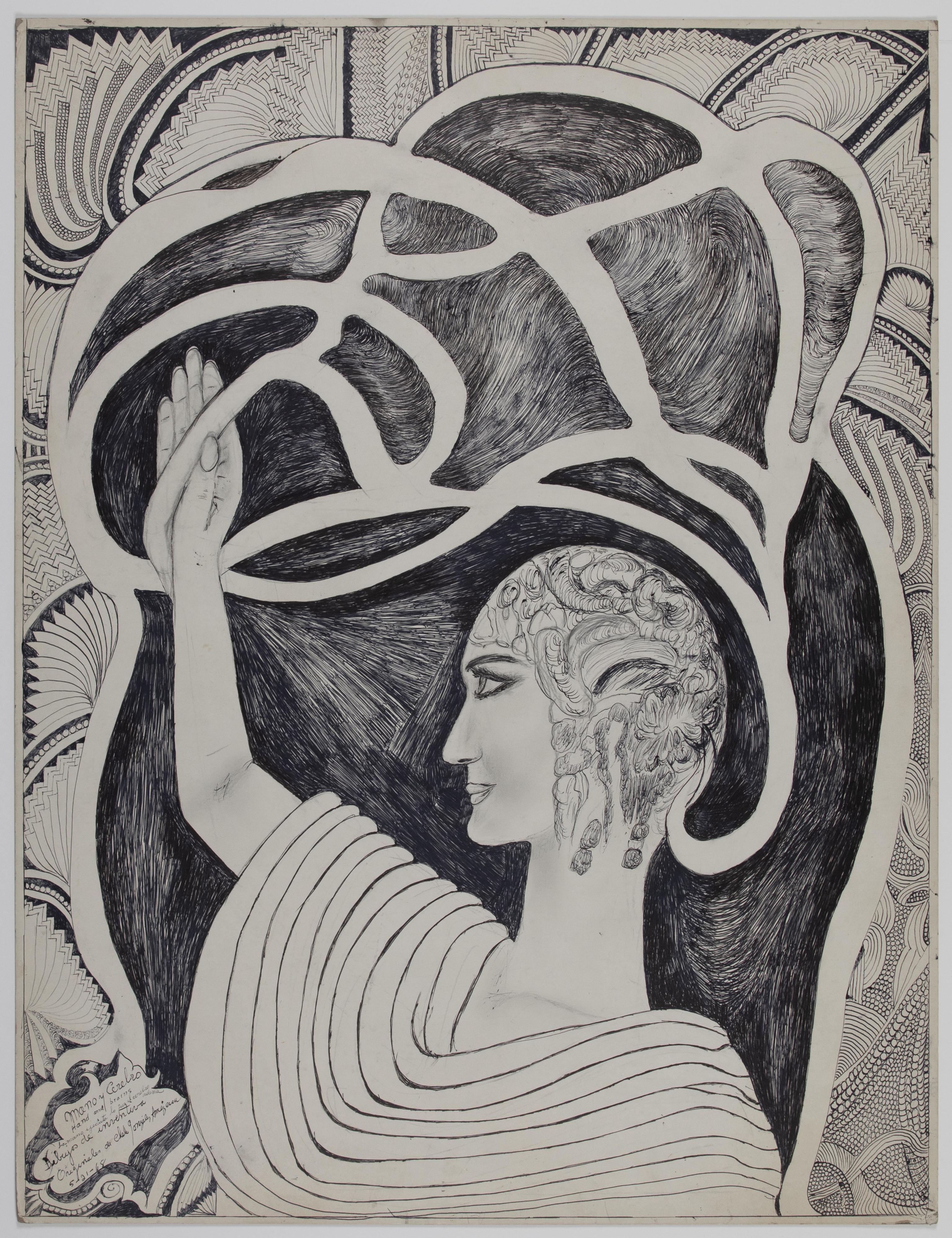
Before Amézcua began creating the drawings for which she is known, she wrote poetry, carved river stones, sought anything that would fuel her creativity. Eventually she focused her prodigious creativity on her drawings. She referred to her drawings as Filigree Art, and the subject matter was as unique as her technique. Her subjects included Biblical figures, usually women from the fables that she had read, philosophers, architects, gardens, music, and her Mexican heritage.
According to her niece, Livia Fernandez, Amézcua rarely sketched a drawing before she started it. She began in one corner and continued the drawing, often taking up to a month to complete it, until it was finished to her satisfaction. Formally, densely filled intricate patterns overlap and dovetail, creating mass. The drawings then open with a path of loose lines or empty space, directing the viewer to the next tableau of dense patterning and imagery on the page. Her preferred medium was an inexpensive ballpoint pen because it produced a dependable line of consistent thickness. She later added coloured pen, and finally marker, to her repertoire.
As an artist Chelo Amézcua was unassuming in presenting herself to the world. She worked in a Kress department store selling candy, and lived a simple life with her sister. Her gentle compassion for mankind is evident in all of her oeuvre, a quality Dr. Rolando Hinojosa-Smith referred to as bondad, Spanish for goodness, excellence, kindness and kindliness. She maintained a ferocious and tenacious dedication to her personal vision of herself as an artist until her death in 1975.
Her drawings are in the collection of the Smithsonian Museum of American Art, Washington, D.C.; the American Folk Art Museum, New York, NY; John Michael Kohler Arts Center, Sheboygan, WI; Milwaukee Art Museum, Milwaukee, WI; the Marion Koogler McNay Art Institute, San Antonio, TX; the Menil Collection, Houston, TX; Collection abcd, Paris,; The Pompidou Center, Paris; and The Museum of Everything, UK.
The Outsider Eye: An exhibition of Outsider and Self-Taught artists curated by Don Christensen, ILLE Arts (Amagansett, NY) 2014
The Visionary Experience: Saint Francis to Finster, American Visionary Art Museum (Baltimore MD) 2014
Great and Mighty Things: Outsider Art from the Jill and Sheldon Bonovitz Collection, Philadelphia Museum of Art (Philadelphia, PA) 2013
Accidental Genius: Art from the Anthony Petullo Collection, Milwaukee Art Musuem, (Milwaukee, WI) 2012
Perspectives: Forming the Figure, American Folk Art Museum (New York, NY) 2010
Approaching Abstraction, American Folk Art Museum (New York, NY) 2009
In the Atrium: Recent Gifts to the Collection, American Folk Art Museum (New York City) 2008
The Message, Das Medium als Künstler, Kunstmuseum Bochum (Bochum) 2008
Parallel Visions II,
St. Etienne (New York, NY) 2006
Wonderland: Visionary Drawings by Chelo González Amezcua, Meadows School of the Arts (Dallas), Pollock Gallery (Dallas), Southern Methodist University (Dallas) 2002
Manos Aladas: Drawings By Chelo González Amézcua, Cavin-Morris Gallery (New York) 2002
Art Spirite Mediumnique Visionnaire: Messages D’otre-Monde, Halle St. Pierre (Paris France) 2000
Spirited Journeys: Self-Taught Texas Artists of the Twentieth Century, University of Texas at Austin, Huntington Gallery (Austin) 1997
The Wind in Their Hair,
American Visionary Art Museum (Baltimore, MD) 1997
A Labor of Love, The New Museum (New York, NY) 1997
Tree of Life, Inaugural show for The American Visionary Art Museum (Baltimore, MD) 1995
Drawing Outside the Lines: Works on Paper by Outsider Artists, Noyes Museum (Oceanville, NJ) 1995
Mystical Elements/Lyrical Imagery: Consuelo González Amezcua, travelling exhibition, Organized by the Del Rio Council for the Arts (Del Rio, Texas) 1992
Consuelo González Amézcua: Filigree Art, Galerias Paco (New York) 1977
University of Texas Medical School (San Antonio, TX) 1971
Brown Gallery/Beaumont Art Museum (Beaumont, TX) 1971
Springfield Museum of Fine Arts (Springfield, MA) 1969
San Antonio Hemis Fair Women's Pavilion (San Antonio, TX) 1968
Filigree Drawings by Consuelo González Amézcua, Marion Koegler McNay Art Institute (San Antonio, TX) 1968
Newton, Nancy, “Chelo Amezcua: Lush Inner Lifer in a Dry Border Town,” Raw Vision #71. Winter 2010/2011.
Lyle Rexer, The Pen: Mightier Than You Thought, The New York Times, April 13
Chelo Gonzalez Amezcua, Art & Antiques, October 2002 Smith, Roberta, “New York Times” Art in Review, 5/10/02
Karlins, Nancy, “Drawing Notebook”, artnet.com, 4/16/02
Lusardy, Martine, Thevoz, Michel, Cardinal, Roger, et al., Halle St. Pierre, Paris, France, 1999-2000, Hoebeke, Art Spirite Mediumnique Visionnaire: Messages D’otre-Monde
Borum, Jenifer P. The Visionary Drawings of Chelo González Amézcua, Folk Art Magazine, Museum of American Folk Art, New York, NY, Fall, 1999
Adele, Lynne. Spirited Journeys: Self-Taught Texas Artists of the Twentieth Century, Austin, Texas, Archer M. Huntington Art Gallery, The University of Texas, 1997.
Rosenak, Chuck and Jan. Contemporary American Folk Art: A Collector’s Guide, 1986, Abbeyville Press, illustrated.
Tucker, Marcia, A Labor of Love, New Museum of Contemporary Art, New York, NY, 1996.
Hoffberger, Rebecca; Manly, Roger; and Wilson, Colin. Tree of Life: The Inaugural Exhibition of the American Visionary Art Museum, Baltimore, Maryland, 1995, illustrated.
Smith, Stacy. Outside the Lines, 1995, Noyes Museum, New Jersey.
Cartin, Mickey, Chelo Amézcua, Inventational Lecture for the Museum of American Folk Art Symposium in conjunction with the 1994 Outsider Art Fair
Driven to Create: The Anthony Petullo Collection of Self-Taught and Outsider Art, Exhibition Catalog, Milwaukee: Milwaukee Art Museum,1993.
Goddard, Dan R. “It’s ‘Convergence Week’ at SWCC,” San Antonio Express-News, Sunday, May 16, 1993, p. 4J, illustrated.
Hinojosa-Smith, Rolando and Quirarte, Jacinto. Mystical Elements/Lyrical Imagery: Consuelo González Amézcua 1903-1975, Exh. Cat., Del Rio, Texas: Del Rio Council for the Arts, 1993.
Roche, Jim (Curator). Unsigned, Unsung...Whereabouts Unknown, Exh. Cat., Essays by Linda Roscoe Hartigan, Judith McWillie, Roger Manly, and Robert Farris Thompson, Florida State University, 1987, illustrated.
“Del Rioan’s Artwork Touring Texas,” Sunday, September 13, 1992, pp. 1A, 5A, illustrated.
Butler, Connie. Art’s Mouth, New York: Artists Space Publication, 1991.
King, Ben Tavera. “Work of Del Rio Artist to be added to Smithsonian Exhibit,”San Antonio Express, December 21, 1991, illustrated.
Quirarte, Jacinto. Mexican and Mexican American Artists in the United States.
Quirarte, Jacinto. The Latin American Spirit: Art and Artists in the United States 1920-1970, New York: Abrams Inc. Pub., 1988.
Rogers, Mary Beth. Texas Women - A Celebration of History, Exh. Cat., Austin: Texas Foundation for Women’s Resources, 1981.
Steinfeldt, Cecilia. Texas Folk Art: 150 Years of the Southwestern Tradition, Exhibition Catalog, Austin: Texas Monthly Press, 1981, illustrated.
Quirarte, Jacinto. Mexican American Artists, Austin: University of Texas Press, 1972.
Lee, Dr. Amy Freeman. “The Hidden Eye.” Filigree Drawings by Consuelo González Amézcua, Exh. Cat., Marion Koogler McNay Art Institute, San Antonio Institute, 1968, illustrated.